
These plum rootstocks are suitable for most European plum varieties, as well as the closely related species of gages, damsons, and mirabelles. There are not as many plum rootstocks as there are for apples, and there are no fully-dwarfing plum rootstocks.
VVA-1 (Krymsk 1)
This cold-hardy semi-dwarf rootstock is becoming increasingly popular in the UK. It is a cross between two minor plum species, Prunus tomentosa and Prunus cerasifera, and can be used for peaches and apricots as well as plums. It produces a semi-dwarf tree, sometimes a bit smaller and sometimes a bit larger than the traditional Pixy rootstock which is no longer used. In the longer term we expect this rootstock is likely to replace Pixy.
Fruit size is better than Pixy and on a par with St. Julien.
As you might expect, VVA-1 is far more cold-hardy than Pixy and St. Julien. It also comes out of dormancy more reliably in the spring.
The main drawback, as with most dwarf rootstocks, is that VVA-1 needs good soil and cannot tolerate drought conditions so it is important to keep the tree well watered over the spring and summer.
Trees available on VVA-1 rootstock.
Plumina
A French semi-dwarf plum rootstock, similar to Pixy but with improved fruit size.
Wavit
The Wavit rootstock is a seedling of a European plum variety called Wangenheim. Unlike most other plum rootstocks it is therefore a true European plum (Prunus domestica) and hence has excellent compatibility as a plum rootstock, whilst also being useful for apricots.
It produces a free-standing semi-vigorous tree, roughly similar to St. Julien or a bit smaller, but of similar productivity and with good fruit size.
It is slightly more precocious than St. Julien - cropping may start in the third year. Another characteristic which is popular with commercial growers is that fruit ripens a few days earlier than the same variety on St. Julien.
It is suitable for a wide-range of soil conditions, with some tolerance of chalky soils.
Trees available on Wavit rootstock.
Weiwa
Weiwa is of similar vigour to Wavit, and like Wavit it is also derived from the Wangenheim plum.
Weiwa was developed at Munich University. It is designed to promote early-ripening and better fruit size.
Trees available on Weiwa rootstock.
St. Julien
St Julien is the most widely-used rootstock for plums in the UK. It is a semi-vigorous rootstock, roughly equivalent to the apple MM106 roostock in the size of tree it produces - although in good soils and in good climates (with good sunshine and rainfall) it can be somewhat more vigorous. If you are not sure which plum rootstock to use, St. Julien is probably the best all-round choice.
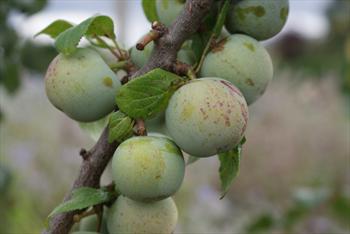 St. Julien fruits
St. Juliens belong to the species Prunus insititia, which also includes damsons and mirabelles, and were originally grown for their fruit, which is not particularly pleasant to eat but useful for drying (see photo right). This nicely illustrates the fact that most fruit tree rootstocks are actually fruit trees of the same or closely-related species which happen to be useful for controlling scion-size, even if they are not that useful for fruit production themselves.
St. Julien rootstocks produce a tree which is substantially smaller than plum trees grown on their own roots. It is compatible with almost all plums and gages. (In fact it is also widely used for peaches, nectarines, and apricots, which are very closely related to plums).
Plum trees grown on St. Julien rootstocks tend to come into bearing after 3-4 years. They can be used to produce free-standing trees (with no staking required once established) and are also ideal for large fans for wall-training - a format which is particularly suitable for plums in more northerly latitudes. A mature fan will be 3m-5m across and 3m or so high.
St. Julien is suitable for a wide-range of soil conditions, with some tolerance of chalky soils.
Trees available on St. Julien rootstock.
Adaptabil
A new rootstock for European plums (and apricots), developed in Romania from a cross of the Western Sand Cherry (Prunus besseyi) which is found in North America. It is similar in vigour to St. Julien but more tolerant of poor soils, including (as its parentage suggests) sandy soils where drought is often a factor.
Jaspi
A semi-vigorous rootstock, very similar to St. Julien but with better tolerance of standing water in the orchard. It is a cross between Prunus salicina (the Japanese plum) and Prunus spinosa (the Sloe, often found in English hedgerows) - both naturally compact species.
Torinel
Developed in France from crosses involving the well-known green gage Reine Claude de Bavay, Torinel is similar to St. Julien in most respects, and suitable for a wide range of soils.
Although it can be used for plums, it appears particularly suitable for apricots.
Brompton
Brompton is a traditional English plum seedling rootstock, used when a "full size" or "standard" tree is required. It tolerates most soils and growing conditions.
Trees available on Brompton rootstock.
Pixy
This rootstock was developed by East Malling Research in 1949 and released for use in the 1970s (it is actually a seedling of a St. Julien) and until recently has been the primary semi-dwarf plum rootstock in the UK. It is no longer used, having been replaced by VVA-1.
It produces a tree somewhat smaller than St Julien, and is also slightly more precocious - the tree will bear fruit about a year earlier than the same variety grafted on St. Julien.
Trees grown on this rootstock will need staking for the first 4-5 years, and require good soil conditions and reliable watering.
Pixy can be considered roughly equivalent to the apple M26 rootstock in the size of tree it produces.